In a year marked by severe disruption, the supply director of a global coffee brand flew to one of their key growing regions. Yields were down, farmers were struggling, and the soil — once rich and productive — was dry and brittle. The drought that year was serious, but the root cause ran much deeper. Years of ecosystem degradation had left the landscape vulnerable — there was no longer any buffer or bounce-back when difficult conditions struck.
That visit prompted a strategic shift. Prices had soared and supply had become volatile and highly unpredictable. The company began asking a new set of questions — not just where their commodities came from, but in what condition those landscapes were. How resilient were they? And how was that resilience — or lack of it — shaping business outcomes?
Storms, droughts, extreme temperature fluctuations, floods, pest outbreaks, and collapsing supply chains used to be seen as rare events. Now, they’re regular headlines. For businesses tied to land, climate, or commodities, these shocks don’t just hit nature — they hit profits.
In this new reality, understanding ecosystem condition offers businesses one of the clearest signals of how well nature can continue to deliver the resources and resilience they rely on. Accurate ecosystem condition data shows how likely a supply base is to withstand shocks, how exposed your business is to these types of risks, and where there is opportunity to increase your competitive advantage. Used well, it’s not just a signal, it’s a profitability lever.


which species are present and in what abundances

the physical structure and complexity of the ecosystem’s habitats

the interwoven processes that connect everything together
Ecosystems are the bedrock of everything. Without them, we would have no water, no fertile soil, no food, and probably no breathable air. They are complex natural systems comprised of species, habitats, and physical elements like water, soil, and nutrients, all interconnected together in complex webs. And each ecosystem is unique: a rainforest ecosystem in South America looks and functions very differently from a European grassland.
When we talk about the condition of an ecosystem, we mean exactly that — what shape is it in? Just like asking about the condition of a car or your health, we’re asking: how well is this ecosystem functioning? Is it healthy? Does it still have integrity? Will it recover quickly from shocks?
The dynamic, interconnected nature of ecosystems makes assessing their state of health difficult, but there is now scientific consensus that ecosystem condition is the sum of three factors:
Together, these factors reflect the ecosystem’s overall health and integrity, and its ability to continue producing commodities for the businesses that depend on them.
Everyone — every person, society, and business — depends on nature. But for some businesses, ecosystem condition is directly tied to competitiveness and profitability. This is especially true for companies that rely on agricultural production of critical commodities, and the institutions that finance or insure them.
Why? Because better ecosystem condition means higher resilience in those agricultural supply chains. And greater resilience means lower risk of disruption, fewer financial losses, and greater business profitability.
Healthy ecosystems are often more productive, but more importantly, they’re also much more resilient. That means they’re better able to withstand shocks and bounce back from stress.
Those with nature-derived, agricultural supply chains that are exposed to disruption risks.
Financial institutions that provide the money and/or insurance to those companies.
Organisations that provide analysis to support market bets on nature-derived commodities.
Ecosystem resilience is the ability of an ecosystem to withstand and recover from disturbances — like storms, fires, disease outbreaks, or human impacts — while maintaining its essential structure, functions, and capacity to support life and produce goods for human use. A resilient ecosystem can absorb shocks and adapt to change without collapsing into a degraded and/or unproductive state.

In other words, the better an ecosystem’s condition, the more resilient it is, and the more reliably it can continue to deliver the goods and services businesses depend on. This resilience stems from healthy biodiversity, strong ecological connections, and a well-functioning balance between living (plants, animals, microbes) and non-living (soil, water, climate) components.
For companies with commodity supply chains, ecosystem resilience underpins the stability and predictability of their supplies. Commodities like timber, coffee, palm oil, or cotton come from ecosystems — forests, farms, wetlands — that are vulnerable to climate shocks, pests, and environmental degradation. When these ecosystems are resilient, they can better absorb disruptions and continue to produce goods reliably. When resilience is low, supply chains become fragile and risky, leading to yield losses, price volatility, and disrupted logistics.
For these businesses, investing in improving and protecting ecosystem condition isn’t just about sustainability — it’s a strategy for reducing risk, protecting long-term profitability, and out competing others by ensuring access to critical natural resources in a world of increasing environmental uncertainty.
Farms embedded in healthy, multifunctional landscapes (e.g., with connected natural habitats, diverse vegetation, and intact hydrological processes) suffer less crop loss during droughts and extreme rainfall. Diversified agroecosystems surrounded by intact natural habitats maintain soil moisture, reduce pests, and stabilise microclimates, supporting yield stability under climate shocks.
Catchments with high ecological integrity (including forest cover, soil structure, species composition, and landscape connectivity) regulate water flows more effectively and buffer both floods and droughts. For example, research in South Africa found that catchments with intact grasslands and montane forests exhibited more stable baseflows during drought and lower peak flows during storm events, compared to degraded catchments.
Ecosystems with intact trophic networks, soil biota, and competitive native communities are less likely to be taken over by invasive species following disturbances (e.g., hurricanes, fire, drought). For example, in New Zealand and Australia, forest areas with high functional integrity were less likely to be colonised by invasive grasses or shrubs after cyclone events, compared to previously degraded areas with disrupted food webs and lower ecological complexity.
Coral reef systems with high biodiversity, structural complexity, herbivore biomass, and low pollution show faster and more complete recovery from bleaching events, like reefs in the Chagos Archipelago (with minimal human pressure and high ecological integrity) after the 1998 El Niño bleaching event.
If your business depends on productive landscapes, you have a critical need to understand the health of the ecosystems that comprise those landscapes. In other words, you need reliable, accurate insight into ecosystem condition. Without it, you’re operating blind to declines in resilience, which means increased supply chain instability, rising costs, and reduced profits. Put simply, if you don’t understand ecosystem condition, you’re leaving money on the table. With the right insights, you can make better predictions and smarter decisions — reducing risks, cutting costs and boosting productivity and performance.
Identify supply areas where resilience risks are rising, and take pre-emptive action
Understand where mitigation efforts will deliver the greatest gains in condition and resilience
Allocate capital wisely, based on likely returns
Track the actual outcomes of your actions and investments — and know if they’re working
Nature intelligence saves money — it’s a net gain, not a net cost. But that only holds true if the intelligence is accurate, and therefore actionable.

Good nature intelligence relies on robust, quality-controlled nature data — on species, habitats and ecosystem function — which must be carefully aggregated and analysed to deliver insights into the true, holistic, and measurable condition of the ecosystems you depend on. Without strong nature data as the input, it is impossible to derive good intelligence. In other words: rubbish in, rubbish out.
Historically, the big challenge was the sheer breadth of data needed. Tracking an ecosystem’s condition requires data on its composition (species), structure (habitat complexity), and function (processes and flows). Until recently, measuring nature and biodiversity in such comprehensive detail was prohibitively expensive and complex, and attempts tended to fall short of the data requirements, meaning they delivered results that weren’t useful or actionable.
But that has now changed. In the past few years, new technologies have solved the data problem by making it possible to collect and analyse vast biodiversity datasets. Technologies from bioacoustics to high-resolution imagery, environmental DNA (eDNA), remote sensing, and AI have transformed how we detect biodiversity. These tech-enabled datasets can be large enough to provide truly useful insights into ecosystem condition at a fraction of the previous cost, which means businesses can now access high-quality nature intelligence to inform better decisions, mitigate risks, and become more competitive and profitable. But even in this new era of ‘big biodiversity data’, quality matters. It is vital to look closely at the data that underpins anything sold as ‘intelligence’, because even tech-enabled datasets can be inaccurate and/or incomplete, which means the results derived from them can still be misleading or unusable.
In particular, it is crucial to understand whether the underlying data sources are the right ones, and whether they’re broad and comprehensive enough to provide truthful nature intelligence that answers the questions you care about. Each of the new cohort of digital biodiversity data types has its own strengths and weaknesses, and there is no one data type that can, on its own, give you reliable nature intelligence.
Good nature intelligence — that tells you the truth about ecosystem condition in places you care about — can only be derived from holistic input data on the composition, structure and function of those ecosystems. That means the input data must capture elements of nature across a broad range of its dimensions, and there is no single data source that can achieve this solo. Any single data type alone (whether eDNA, imagery, acoustics or anything else) provides information on only a single ‘slice’ of the ecosystem. Producing accurate intelligence on ecosystem condition requires bringing together a broad range of these input datasets — from ground-level imagery and habitat data to acoustic recordings, eDNA samples, satellite imagery, and more. Only when analysed together can they build a holistic, dynamic assessment of how the ecosystem is functioning and changing in ways that matter to your business.
So while it can be tempting to rely on one data source — for example, a species list from eDNA samples or tree cover data from satellite imagery — doing so will rarely, if ever, generate intelligence that is accurate and meaningful to you. And when there’s a business-critical need to know the truth, that distinction really matters.
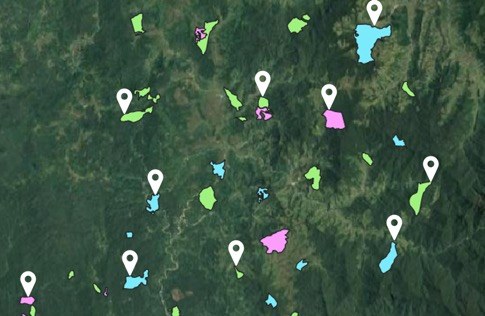
Farms (coloured polygons) are selected for biodiversity data sampling (white pins) based on their key characteristics. It is not necessary to sample every farm, but sampling must be dense enough to allow interpolation, and must be unbiased and representative, to ensure conclusions can be drawn about what correlates with ecosystem condition across the supply shed.
Alongside ensuring breadth in the input data types, data ‘depth’ is also key to generating good nature intelligence. Biodiversity is so complex that it is almost always impossible to capture every single component, and biodiversity data is therefore usually sampled — meaning we capture data at selected locations, and use these data samples to infer across a wider area. The quality of the sampling approach — how much of each type of data is sampled, where and how often — determines whether the resulting datasets are deep, unbiased and rich enough to provide accurate, useful intelligence.
Insufficient data sampling translates into poor insights — for example, big year-to-year fluctuations that reflect sampling gaps, not actual ecosystem changes. Too much sampling — beyond what is necessary to draw robust conclusions — adds cost and complexity without adding much value. Biased sampling leads to false conclusions. The key is balance: getting enough data in the right places to draw reliable conclusions, while keeping things efficient.
For example, imagine a 50,000-hectare supply region, with 5,000 farms. If you collect biodiversity data from 10 of those farms and extrapolate to the whole region, sampling will be so sparse that it will be impossible to control for variation — for example, in things like elevation, farm practices, or water availability — and the results from the 10 farms will almost certainly tell us nothing useful about condition elsewhere. On the other hand, sourcing biodiversity data from all 5,000 farms results in a very rich dataset that can answer a myriad of questions about ecosystem condition across the landscape, but invokes unnecessarily high cost and complexity.
The solution is smart sampling — selecting farms that represent key variations across the landscape, using statistical design to ensure data is deep and unbiased enough to answer real questions, while keeping costs and complexity down. This statistical design phase determines whether the resulting intelligence will actually help you make better, more profitable decisions.
And data alone isn’t intelligence. Once data has been collected, it only becomes intelligence once it’s been brought together in an analytical step to produce metrics that quantify and communicate the multiple aspects of condition.
These three elements are the key to accurate, actionable ecosystem condition intelligence:
By doing these things well, we can create intelligence that empowers decision-makers to act confidently — protecting ecosystems and the bottom line.
Pivotal is the leading provider of nature intelligence. We’ve built the data infrastructure to measure holistic ecosystem condition and resilience at huge scale, across entire supply sheds, landscapes and supply chains.
Everything we do is designed to produce metrics that tell the truth about ecosystem condition and resilience, and therefore to enable our customers’ success. We combine multiple sources of primary, ground-level biodiversity data, apply rigorous statistical methods, and ensure every insight is reviewed by expert ecologists.
The result is true, trustworthy, decision-ready intelligence on the holistic condition of the ecosystems our customers care about. We show you which areas are in good or bad shape, how they’re changing, and what’s driving those changes.


Pivotal’s nature intelligence blends multiple primary data sources to deliver deep, actionable insights at scale.
Unlike single-source nature data, our approach delivers a full picture of ecological degradation across landscapes and supply chains.
Our careful, data-driven statistical sampling enables year-on-year and place-to-place comparisons across different land uses, locations, or supply sheds.
Our intelligence informs operational decision-making that builds future resilience and competitive advantage.